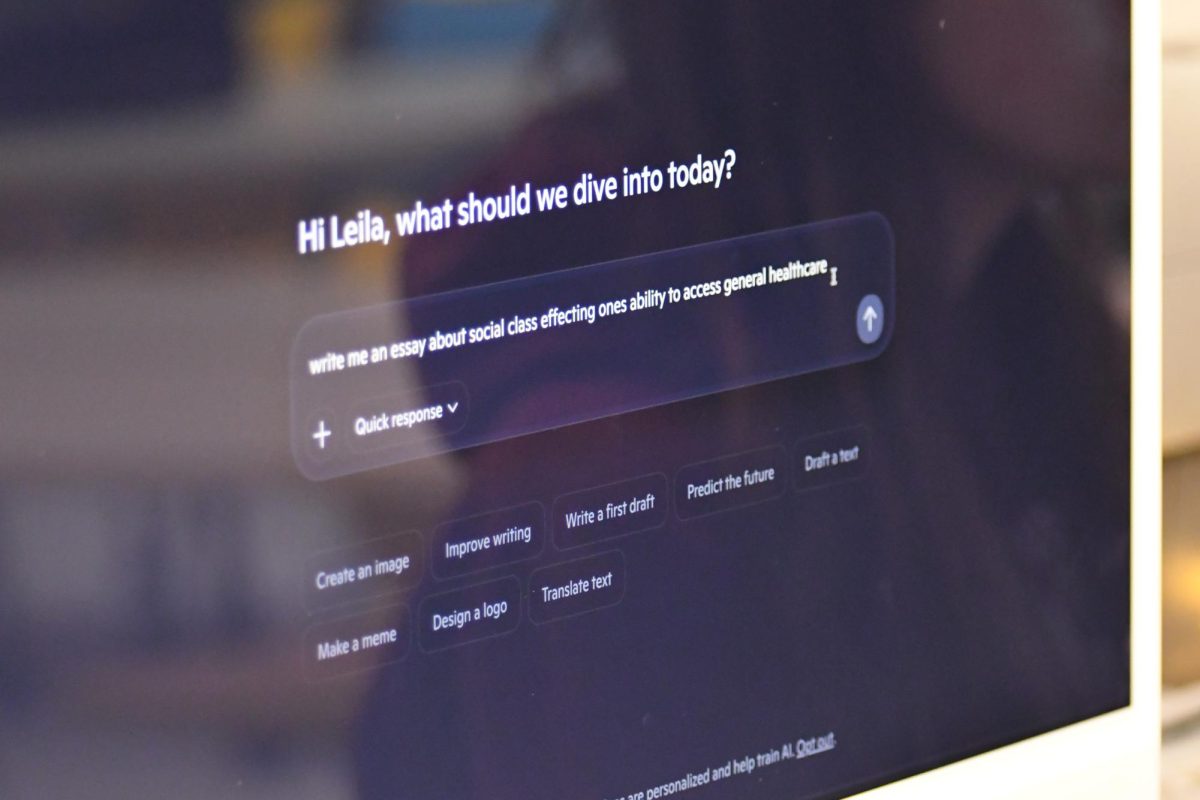
Artificial intelligence has done more than surpass boundaries—it has helped to create new ones. The introduction of modern artificial intelligence to the public has sparked several controversies, raising questions about how society must come to terms with these new complications. A widespread debate, and one prevalent at Lindbergh, is the debate over the use of AI in the classroom.
The popularity of artificial intelligence among educators is rapidly increasing. In the 2024-2025 school year, data from The 74 News Outlet showed that 60% of teachers saved up to 6 hours a week of work by using AI. Additionally, students themselves have been using AI for homework and research assistance; because of this, numerous schools across the United States have developed mixed feelings about the potential impact of these changes on modern education. Ms. Maassen, an AP Seminar teacher at Lindbergh, shares her opinion and boundaries regarding the use of AI in the classroom.
“I know in the future, it’s going to be like what the calculator is to math class. But that’s really hard to accept at the moment because it feels like cheating,” Maassen said.
Despite similarities between the two, a calculator utilizes specific pre-set algorithms to perform mathematical tasks; on the contrary, AI is a dynamic platform capable of providing information across various fields, learning lessons based on past “experiences,” and, ultimately, acting as its own individual entity. In a recent interview with CNBC, however, OpenAI CEO Sam Altman noted that the phrase “a calculator for words” is his preferred description of AI’s future possibilities.
“AI is the most important thing to happen in a very long time,” said Altman.
Contemporary Issues and AP Government and Politics teacher Ms. Weitzel also sees the potential of AI, believing students can use it to their advantage.
“AI is actually a good thing. It can be used, if correctly, in good ways [and] to foster creativity…I do think that there are several good uses of AI, and so I think that we should be teaching students how to use AI appropriately in the classroom,” said Weitzel.
Lindbergh Psychology teacher Ms. Sarah Saunders elaborated on her understanding of the relationship between cognitive function and artificial intelligence.
Saunders states that using AI cuts down on your activation of certain neural pathways that solve problems. Over time, one can see negative results, and even possibly lose critical thinking abilities.. “You need to activate certain parts of your brain [to] keep them active for when you’re older. And if those are the critical thinking areas, because you’ve depended so much on AI or these other tools to [think] for you, as an adult, you won’t have that capability. You’ll be limited.”
Saunders claimed that the use of AI during adolescence could have several detrimental effects when not correctly used or regulated.
“The problem with a shortcut is that you have to know the long cut first. You have to have that long cut memorized … [AI] can be used as an aid, as an accessory,” said Saunders, “but it cannot replace your thinking.”