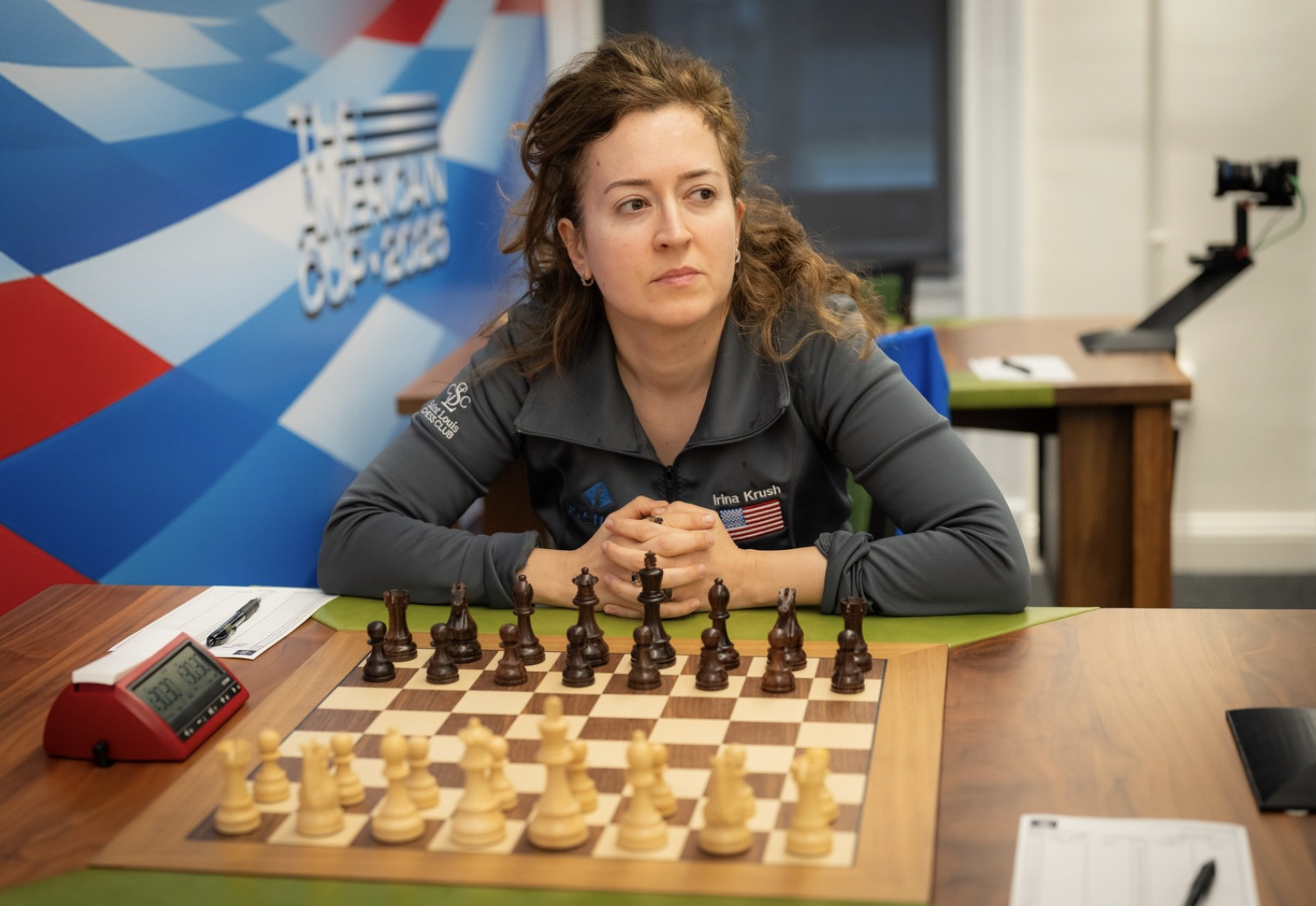
In 2013, competitive chess player and U.S. Chess Hall of Famer Irina Krush, who has extensively competed in the St. Louis metro area – often referred to as the “Chess Capital of the World” – and has been a residential grandmaster at the St. Louis Chess Club made a huge breakthrough when she became the first woman to achieve the highest-ranking “Grandmaster” (GM) title while competing for the United States.
Prior to this, in 1998, she had become the youngest U.S. Women’s Chess Champion at just 14 years old. Since then, she has been featured in an episode of The Steve Harvey Show with Hillary Clinton, The Price is Right and several articles published in The New York Times. In 2024, she became the first recipient of the Cairns Chess Queens Award.
And, just this March, Krush sat down for a brief interview with Pilot to reflect on her previous achievements, the future of competitive chess and her experiences as a female player in a male-dominated sport.
Mira: So, where did you play your first chess game, and can you tell me about this experience?
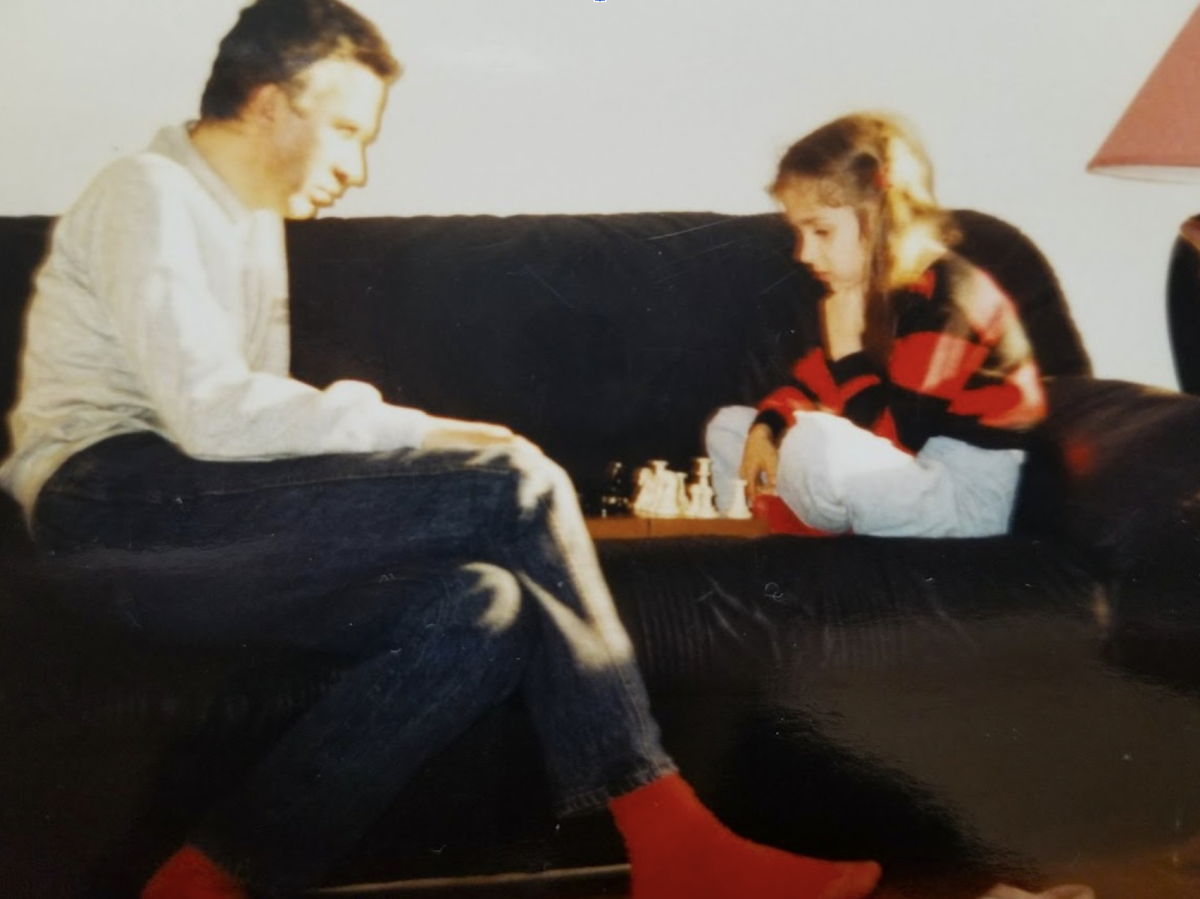
Krush: So, let me see if I have any pictures of this. Okay, so I have some pictures of me when I was playing as a kid, and this is one of my first tournaments. I don’t know if it’s the absolute first tournament I ever played in, but it was one of the first — I believe this is [at] the Manhattan Chess Club. You can see the other one of me playing this guy right here. Same guy. So, yeah, I mean, actually, even like my first tournaments were against adults. I mean, obviously I played kids too, but this is probably [the first] rated event I played or one of the first. I think there’s one more picture here. That was my first World Youth Championship, actually. This one in Poland. I was seven years old in that one.
Okay, so you asked me to describe these first events. What I remember is that I won money in my first tournament. Maybe it was twenty dollars or something, and we went to a big toy store in New York to celebrate that. That’s a good memory from that first event.
M: That’s really cool. Do you remember what you got?
K: I don’t remember. No.
M: Who do you think had the biggest influence on your decision to start and continue playing chess?
K: Well, definitely my father. My first teacher was my dad. I would spend a lot of time on that black sofa with my dad. So he was my first teacher for a number of years, [although] I was actually quite good already. He is, I think, the biggest reason I became a chess player — because it’s something that my dad really loved, and he still loves it. He still plays on chess.com all the time — more than I do.
M: What’s his chess.com rating?
K: What’s his rating? It might be maybe two thousand or something like that. I don’t keep track of it, but it’s pretty high. Like, he’s a good amateur player. Yeah.
M: What was the biggest obstacle you faced as a female chess player in a very male dominated sport?
K: Yeah, that’s a good one. The truth is, I don’t feel like I faced a lot of obstacles as a female in chess. Maybe I was lucky in terms of the timing of when I got into the game — in the early 1990s, right? This is already, you know, not like the 1960s. It was the early 90s. It was in New York. New York was like a chess center in the United States. I mean, there might not have been a lot of little girls playing…I mean, like, looking at that picture [of] my first tournament, none of these people are little girls. But that’s just kind of what it was [and] what I got used to.
I don’t consider that some big discouraging thing because I got into [chess] when I was young. That was the chess scene. I kind of accepted that as normal. It didn’t bother me. And I felt like, overall, chess was a very welcoming world. I made a lot of friends in chess — boys and girls, older people — were always there because chess is not separated by age. And those people at the chess clubs were friendly. I think everyone has their own experience, but for me, it was really a positive experience, and this is actually why I’ve been in chess my whole life. Maybe if I would have had a lot of obstacles, who knows [what] I would have chosen [to do], right? But it’s actually because I feel like I always felt very comfortable in the chess world. I mean, I really don’t have a lot of stories of something negative pertaining to me being a girl. So yeah, I would say my experience has been good. I think, in general, chess is a very merit-based field and as long as you have abilities when it comes to actual chess play you’re unlikely to hear anything other than respect.
M: I know you talked a bit about getting into chess earlier in your life, but I wanted to know: When specifically did you first know that you wanted to pursue a career in competitive chess for a fact?
K: So, just one thing before I answer that one. I do see that the chess scene now is very different. Now, when you see a little girl in the chess club, it’s just so common. There’s tons of them at the Marshall Chess Club, right? But when I was growing up, it was not that common. It was me, and that was it. Still, despite that, I mean, I see the change, but I can’t say that it was a big deal back then. So, maybe I just got lucky. There were supportive people, and no one [was] unwelcoming.
I [also] had a breakthrough year when I was 14 years old. That year really had a lot of success. There were three big things that happened that year, kind of one after the other in the second half of the year. First of all, I qualified for the U.S. Olympiad team for the first time, and I played on the second board, and I did really well. So that was one good thing.
I also won the U.S. Women’s Championship with a score of, like, eight-and-a-half out of nine which was completely
unexpected — [for me to] have such a big, big score. I also won a medal in the World Junior Championship, a bronze medal, when I was 14 and [the tournament] was under 20. Those were three pretty big things that happened to me in that year, and from that point on, it was clear that I was going to be doing chess. School sort of took a smaller focus, and we made some arrangements where I could study from home, travel more, all of that. I would say, from that point, it was just no looking back.
M: Well, first I want to tell you congratulations, that’s amazing, and second, I’m also curious — what are you thinking as all of this is happening? Were you like, ‘Wow, all this big stuff just happened,’ or were you more like, ‘Oh, yeah obviously that happened’?”
K: You know, I think when you’re at that age, you’re not doing a lot of analysis of what’s going on in your life because you don’t really have things to compare it to. So, you’re just kind of living. Looking back, you’re always like, ‘Oh, those were some big things,’ right? But when I was in the middle of it, I think I was excited about the achievements — I was excited because it really was like it felt like a breakthrough [and] it was going to open up a lot of opportunities for me — but did I think life is changing in a major way? I probably didn’t.
M: What do you think is the most important chess game you’ve ever played?
K: I mean, honestly, there’s so many important points in your career [that] it’s hard to single out one, but I would say in terms of what has definitely made a lasting impact, [it] would be the game that I won and the game that wound up giving me a grandmaster norm and my title. It was in the Baku Open in 2013 and I beat this grandmaster, Vasif Durar Bailey. Because getting the grandmaster title was just like something that I’d been kind of going for for many years. And I became the first American woman to do it. And I still am the first American woman to do it. I think there will be more, but still this has been for, I don’t know, 13 years now. So, it wasn’t so simple. And I did it fairly late in my career, when I was I think 28 or 29. Yeah. I was 29 years old. It’s pretty late, but I managed to do it. And, obviously, I think that’s something that was important for me in my life, where you get that highest title in chess that relatively few women have gotten. When I got it, there might’ve been like 20 women who were grandmasters in the world. So, yeah, you’re joining a pretty small, small club and, probably, that game made the most difference for my life.
M: So, you’re the only woman to earn the grandmaster title while playing for the United States, and you’re also an eight-time U.S. Women’s Chess Champion and two-time Women’s American Cup Champion. What does this all mean to you, and how do you hope this could inspire other female chess players?
K: Hmm. Well, you know, first of all, I want to say that the inspiring thing I’ve learned in this game is the game of chess itself. I’m very happy that my dad taught me this game and pushed me to get started in it. And, eventually, the decision to stick with it was my own, right? The game of chess inspires me, you know, and I still have a lot to learn in chess. That’s kind of how I see it. I mean, it’s nice, I guess. I guess I’ve managed to do a few things in chess, and I guess it’s nice to get recognized for that, but it’s not something I spend a lot of time thinking about. I’m always thinking about how to make my next achievement, honestly. It’s more inspiring to be like, ‘Well, how do I win the American cup again?’ or, ‘How do I win the U.S. Championship again?’ more than being just pleased that I’ve done it. There’s always a time where people are like, ‘Well, I’ve done enough in this area, and I can just focus on other things,’ and that’s totally reasonable, I think, for someone at my stage in life. I could say, that just happens [and] that I still really like chess and I want to do more in it. So, yeah, all the past things are not so meaningful.
M: That’s a very interesting perspective. On a similar note, I also wanted to ask: What is some advice you would like to give to aspiring female chess players?
K: Well, I would say to get really immersed into it. Chess definitely is something that requires a lot of immersion — from all points of view — studying chess, playing chess, tournaments, playing chess online, doing your tactics. So, I think that’s what it is. It’s like learning a language, right? You need immersion. Chess is a language. In fact, people often stand to say it’s the ‘chess language’. So, yeah, that’s what it is. It requires immersion, and the sooner you start doing it, the better and the more proficient you can get at this language.
M: What do you think drives your passion for chess the most?
K: What drives my passion for chess? Well, it must be the game of chess itself. I think, you know, when you hear Magnus Carlsen talk about chess, it’s kind of similar. He just thinks it’s a great game, right? Just kind of unapologetic about it. Just saying that the game is great. That’s why he says he would teach his kids and everything, because what can you say, ‘don’t play chess’? That’s never been good advice, ever. I think the unending nature of chess is something that is absorbing to the mind. First of all, it’s not something really repetitive based. Even though there’s computers in chess, and there’s always been talk about computers ‘narrowing’ chess, chess still allows a lot of scope for creativity. You can play chess your whole life, and it doesn’t really get old. That’s what I think it is.
Also, it’s openings. I mean, some people maybe have learned them all, but I haven’t, so I feel like there’s a lot that I can learn. You can study games of players that you’ve never studied before, you can train with puzzles or books that you’ve never seen before, like, new positions, right? Chess is just not boring — it’s constant problem solving in front of you, and there’s beauty in it too. It’s not like you’re doing some random tasks, it’s like you solve it and you can get a lot of satisfaction. Even yesterday night, I was solving puzzles on Lichess with a friend of mine, and sometimes there’s a certain move, and you’re just, like, ‘that is so good’, you know what I mean? It’s so cool, it’s so deep, and you appreciate it. so It hasn’t gotten old to me, and I feel like that makes sense. There’s so many permutations in chess, and it’s just endless. I feel like I can keep learning and keep developing myself through playing chess. The game is interesting on its own, and it’s also [about] what you can pull out in yourself from playing it. I feel like I’m not done with one or the other; chess has always been a really good battleground for me to test myself.
M: In an interview with the U.S. Chess Federation, you said that your favorite opening was the Sicilian; however, you never said why. So, I just want to know, what makes that your favorite opening? Is it still your favorite opening?
K: Oh, so you did your research. Well, you know what, yes — I think I know where you read that — I can recognize why the Sicilian Defense is my favorite opening. Actually, I spent a month and a half in Sicily last year which was kind of funny; it was just a coincidence that I went to the birthplace of my favorite opening, the Sicilian Defense.
In chess, it’s considered one of the most exciting [and] richest openings. It’s a very double-edged opening, which often has opposite sides castling, often has sacrifices, attacks…but also strategic ideas as well. It’s very versatile. I’ve played this opening since I was a kid. It’s also something that I am not tired of. I’m willing to learn new things, too.
M: This question is a bit unrelated, but I wanted to know if you think that playing professional chess is a gift you were born with, or something that you had to work hard for and then become good at later on.
K: I think it’s kind of both. Like, I definitely showed aptitude for it from an early age, which is why my dad started teaching me and continued teaching me — because he saw that I was taking to it, and I don’t think it was the kind of thing where I was awful at it — and then, eventually, I became decent. My dad saw that ability — I mean, I played my first world youth championship when I was seven, representing the U.S. and the girls under 10. It was, like, yeah, that was an early age for an international competition. Also, even in that picture where I was playing those older men and still won money in my first tournament, you can see that these little things show that there was aptitude. But, of course, you got to build on it, right? There were a lot of things that had to go with that, which is my commitment, my parents’ commitment…someone had to take me to tournaments, someone had to find the money to take me to tournaments, right? It was a team effort. I think there was a lot of time spent on chess as a kid, and if I wouldn’t have had that breakthrough when I was 14 and didn’t get those very clear signs, maybe my life could have gone in a different direction. It’s just that I got those signs quite early on, and that ‘okay, this is your thing’.
M: What direction do you think that you would have taken if you weren’t going to be a chess player?
K: I think a lot of things. I could have been studying. School was always not a burden to me. I always enjoyed it, [and] I think chess also kind of cultivated that in me, this sort of ability to think focus, analyze, process, digest, synthesizing all those things. I never didn’t enjoy school…I didn’t mind missing school to do chess, but like I never hated school in any way. Learning was always just fine for me.
I think there are many directions I could have gone into at different points of my life. Some people are like, ‘you’d be a good doctor’, because I’m into health, wellness, medicine, all this kind of stuff. If you enjoy learning, you’ll pretty much be good at anything you want to do. In terms of my interests: at some points in my life, I thought I could be a lawyer because I like to read and write and analyze and debate, but I don’t know, it’s just one path out of many. Or, I could be a writer because I used to love to write and read. I don’t know what I would have been if I wasn’t a chess player, it’s hard to say.
M: Going back to what you were saying about prepping for tournaments…how do you like to prepare for them?
K: It’s a combination of looking at your opponent’s games, seeing what they play, thinking about what you might play, doing puzzles trying to be sharp, trying to play some practice games with your friends. If you have time, you can go and play a tournament, but if you don’t, you’ll just play online training games or work on some of your openings. It’s kind of multi-faceted, and sometimes you go in without all of those things and you still do pretty well, and sometimes you do more of those things and you still don’t do well. It’s not a 100 percent correlation. I think it’s interesting because it’s not like some other sports, where if you run, you know you can run and you know that you’re capable of doing it. In chess, it’s not exactly this one-to-one thing. You might be at a certain level, and able to do it at a certain level, and still have a really bad event. It’s not exactly clear, and it’s a little more mysterious in chess what causes a really good tournament. Sometimes one tournament is good and the other one is not so good and it’s not in between events. So, that’s kind of an interesting thing about chess.
M: Yeah, that is pretty interesting, especially for a sport.
This is just something I’m curious about: Do you ever look yourself up online or read articles about yourself?
K: I’ll be honest…not much, really. I mean, I look up other people if I’m interested in someone else, but do I look up myself? Yeah, not much.
M: Is there a specific reason behind why you don’t?
K: I don’t know, it just hasn’t occurred to me. I already spend all day with myself. I know myself pretty well. If there’s some interview that I did that I know would come out or something, sure, I would read that, but I’m not particularly searching out like, ‘Hey, it’s a random Wednesday, and after I talk to Mira, I’m gonna go see if there’s anything written about me online!’ like, no.
M: That’s interesting. I feel like if I were famous I would look myself up.
Those were all the questions…is there anything else you wanted to add, or something else that you would like to share?
K: You know, be tough. Don’t take losing too hard. There’s a lot of advice that you can give to kids, but I would say the first one is to immerse yourself. Also, I coach kids, and I recently came back from the New York State Championship — one of our students was doing really well, but he lost his last round game, and he’s crying and really disconsolate. I look at his game, right, and it’s really a pretty good effort. Like, this kid at his rating is playing a good game. I can tell that he’s trying.
It’s not some terrible effort at all. I explained to him [that] there’s nothing to be to be ashamed of…you you did your best, and just because it wasn’t quite enough in this game for the results you wanted does not make this a disaster. You didn’t embarrass yourself or let anyone else down. That’s like an important lesson in chess. Sometimes, you do everything and you still don’t get the results you want, but that’s okay. It’s a part of the whole process. And, sometimes, you can lose and you’ve done better than if you would have won. The reality is, you might’ve actually done more and tried harder in that game than your game where you got a better result. So, there’s differences. Even in chess, there is a difference between winning and losing. Like, depending on how you win or lose, the loss can actually have more value than a win. Even though on the surface, it looks like you just suffered a defeat.
You have a chance to learn this important thing that, in the end, the result is important, but it’s not the value of the whole thing. You have to recognize those differences. You can lose because you didn’t try or because you didn’t focus, or you can lose when you did your best, but, for some reason, in this game it wasn’t enough. You should learn to tell the difference, and then you don’t have to be as upset at yourself when you’ve done your best. So, yeah, there’s a lot of lessons that chess can teach you. Not every loss is the same, and definitely not every loss is a failure. The game itself is really interesting, and it also develops you in so many different ways. It’s a great self-improvement tool, and I think it’s worth it to learn chess.