On Tuesday, Feb. 24, President Trump stood before a divided Congress to give a State of the Union address focused on the economy, immigration enforcement and what he called the restoration of American strength. The speech, which ran 108 minutes, was the longest presidential address to Congress on record and highlighted the deep partisan divide inside the House chamber.
Trump defended his use of tariffs despite a recent Supreme Court ruling limiting aspects of them and advised Congress to pass the SAVE America Act, which would require proof of citizenship to register to vote. He pointed to a decline in border crossings, emphasized new tax legislation passed by Republican majorities and blamed Democrats for high costs facing families.
Trump implored Congress to stand if they believed the first duty of the American government is to protect American citizens, not “illegal aliens.” Republicans frequently stood and applauded. Most Democrats stayed seated, showing little reaction.
Government and AP Comp IR teacher Mark Newton expanded on the purpose of the speech.
“It was to restore confidence in the economy and to build up momentum for the midterm election in November,” Newton said. “It was to build patriotism and to take credit for success,” Newton said.
However, before Trump moved far into his remarks, another message had visibly taken place across the chamber. Congresswomen once again wore white in protest, but this time in opposition to the SAVE America Act.
AP Government and Politics and Contemporary Issues teacher Lexie Weitzel highlighted the potential consequences.
“We don’t have a ton of election fraud, and what the SAVE America Act does is it makes you provide more documentation. I don’t think we should be making it harder for people to vote. I think we should be making it easier for people to vote,” Weitzel said.
Only 0.04 percent of voters were noncitizens, according to the Bipartisan Policy Center. While aimed at lessening fraud and noncitizen voters, the act could threaten the right to vote for many Americans, specifically women.
“[The SAVE America Act] makes it harder for women who are married, or who have changed their name or don’t have the proper documentation,” Weitzel said.
Outside of suffrage protests, people wore white to support other marginalized groups as well. In opposition to Immigration Customs Enforcement (ICE) and Trump’s deportation agenda, anti-ICE demonstrations surfaced nationwide. The color white also appeared in the recent ICE walkout staged near the Lindbergh High School entrance. Student protest organizer Kylie Stafford encouraged those unable to participate to show their support by wearing white clothing.
“I told people who can’t make it but want to support to wear white. This allows people to show support even if it is from the sidelines,” Stafford said.
As Weitzel pointed out, these actions are shared by women of all ages and status across the country.
“Women are taking chances and making progress to break some of the barriers that we have. They could be people that are well known or people even in our community,” Weitzel said.
In 2017, Democratic congresswomen planned to wear white to represent the importance of women’s rights. The color white continuously reappeared in women’s suffrage protests, symbolizing purity and non-violence; other protest colors include purple, yellow, green and recently—pink. During the early 20th century, suffragists frequently wore white dresses during marches and demonstrations to represent solidarity within the movement.
Many of the Democratic congresswomen chose to wear white to the State of the Union in order to signal that the fight for women’s rights and voter access remains constant. While the President called attention to economic growth and national security in his speech, the congresswomen’s collective display reminded the public that policy debates around voting rights and women’s autonomy remain deeply contested.
“The president has appointed judges that have ruled against women’s choices in certain organizations. When there have been actions like the Me Too Movement, and there’s a chance for the president to support it, the president has been confrontational with the movements,” Newtown said.
That similar sensation of ongoing advocacy can also be seen in how political leaders continue to form women’s rights as an active, unfinished effort. Missouri Rep. Ann Wagner, a St. Louis native, voiced her efforts to strengthen women’s participation in politics. The first female chair of the state Republican party, and later a Republican National Committee co-chairwoman, Wagner contributed to the Winning Women initiative. The initiative increased women’s representation through leadership, involvement and empowered conservative women candidates.
“I believe all Americans should be able to live free from discrimination. Our communities are strongest when we treat others as we would like to be treated,” she said in a 2013 interview with the political news website, The Hill.
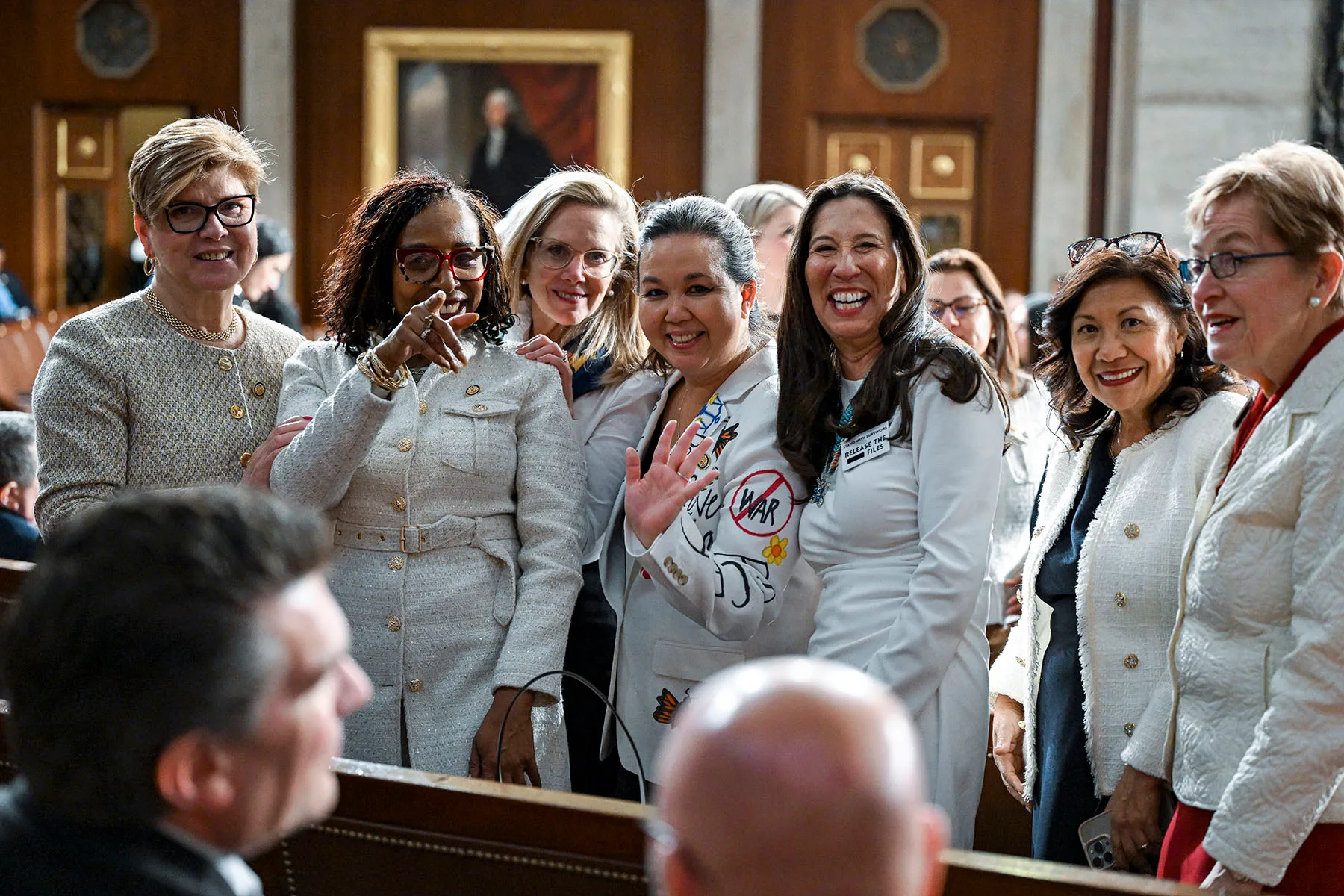
Reps. Nellie Pou, Yvette Clarke, Jill Tokuda, Teresa Leger Fernandez, Norma Torres, and Macy Kaptur wear white to President Donald Trump’s State of the Union address on February 24, 2026 in Washington, D.C. Photographed by Kenny Holston-Pool.