On April 20, 1999, American history was redefined.
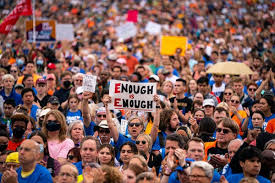
The mass shooting of Columbine brought incomparable urgency and nationwide attention to the gun violence discussion. It challenged the law, threatened traditional values, and sparked an ongoing outrage. And now, nearly thirty years later, society continues to face the consequences.
“I think students feel less safe than they used to, you know? It’s really interesting to me—this has been a topic I’ve tracked my entire educational career. My first year of teaching was the year that Columbine happened, and Columbine was the first. It wasn’t the first school shooting, and it wasn’t even the first mass school shooting, but there was something about Columbine that was different, that really got this country’s attention. And it has felt like, since Columbine, these things have just been happening with greater regularity,” said Lindbergh High School principal Dr. Cochran.
Since Columbine, the frequency of active shootings has increased exponentially. According to Statista, in 2023 alone, there were 350 separate incidents—the most documented in a single year. Although these events have brought more attention to the issue, the crisis remains unsolved. Recently, however, many Americans have begun to wonder if the country’s lack of official gun laws could be playing a key role in the situation’s increasing severity. Ms. Weitzel, Lindbergh’s Contemporary Issues and AP Government and Politics teacher, provided her insight on the situation.
“I do think that there are policies that can be put in place [without] taking away the right to bear arms. I think we should meet in the middle and compromise to keep our guns, if you want to keep your gun, but also think about how we can make the process a little more difficult if someone is struggling and gets their hands on a gun. There’s a lot that we can do to tighten up our policies so people still have the right to bear arms, but [are] still kept safe,” said Weitzel.
The regulation of firearms, or lack thereof, is perhaps among the most infamous of modern political discussions. Controversial in nature and frequently at the center of heated debate, the conversation has maintained relevance in American thought for decades. As reported by researchers at Cambridge University and the National Library of Medicine, these conflicts have only increased in tandem with the growing popularity of cell phones and online platforms; consequently, the new generation now holds an unceasing political war in their back pockets. Dr. Cochran expressed his concerns regarding the negative influence that the online provision of these topics has on adolescents.
“Like just about anybody in this country, I have my own personal views about the causes of gun violence in the country. It’s probably multifaceted. I am generally concerned about the impact of social media in a variety of ways. I think it has impacted our political environment [negatively]…it’s driven a lot of people to extreme views that ordinarily, without social media, probably wouldn’t have some of those extreme views,” said Cochran.
The recent Pew Research Center article, “Algorithmic Categorizations Deepen Divides,” along with numerous other studies, have suggested that social media algorithms are designed to cater to users by often withholding ideologically diverse content; this has partially contributed to recent polarization and heightened tensions surrounding the gun violence discussion. Ms. Saunders, a Lindbergh AP Psychology teacher, defines this phenomenon as “echo chambers,” a psychological concept referring to the creation of isolated ideological communities through the lack of promotion of diverse content, opinions, and perspectives.
“[Echo chambers] only create a larger or more intense feeling. So when you’re in a group like that (it’s called an ‘in-group bias’), your ideas and beliefs tend to become more extreme as you talk, and as you hear this. You begin to move further away from the center, the more you engage with that. Is that division going to
create less of an opportunity to come together as people with differing beliefs? I don’t know, I can’t see the future. But what I can say is that it is creating a political divide because that [social media] algorithm is only showing you certain things. The solution to that is to always look at both sides of any issue,” said Saunders.
Though the debate of gun regulation is, and may remain, controversial, American citizens of all political affiliations can agree on a common goal: preserving educational safety and protecting loved ones.
“I sincerely believe people on both sides of this issue want the same thing: they want this to stop. Nobody wants this. And the fact that we’re not able to sit down and listen to each other and compromise the way people have compromised in this country for well over two centuries is frustrating. Frustrating that we’re not able to do what we used to,” said Cochran.